Book Report: The Old Man and The Sea
A book report on Hemingway's 1952 novella, covering Santiago's struggle and whether the ending lands.
 By Emilio Alcántara6 min read
- English
- Writing
- Book Report
The Old Man and the Sea
Book Information
| Title | The Old Man and the Sea |
| Author | Ernest Hemingway |
| Genre | Literary Fiction, Adventure |
| Published | 1952 |
1. Introduction
Is it really worth the struggle?
Ernest Hemingway explores the nobility of perseverance and success in his prize-winning story, The Old Man and the Sea (1952), where an aging Cuban fisherman struggles against a giant fish.
Hemingway lets us see through the obstinate endurance of Santiago how strong the human spirit can be. Despite his age, Santiago’s determination to succeed portrays perfectly that there is no obstacle or enemy that can do us harm when our desire is greater.
Commitment, honor, and resistance are the main themes that Hemingway conveys in this powerful yet concise narrative.
2. Setting and Context
The narrative is set over two different scenarios, one longer than the other. The duality of the setting can be portrayed perfectly as two different places are evident.
First, we have the safety of Santiago’s house on the coast of Havana, which serves as a starting point for this story. Even though it was safe and cozy, Santiago knew the duty of a fisherman awaited.
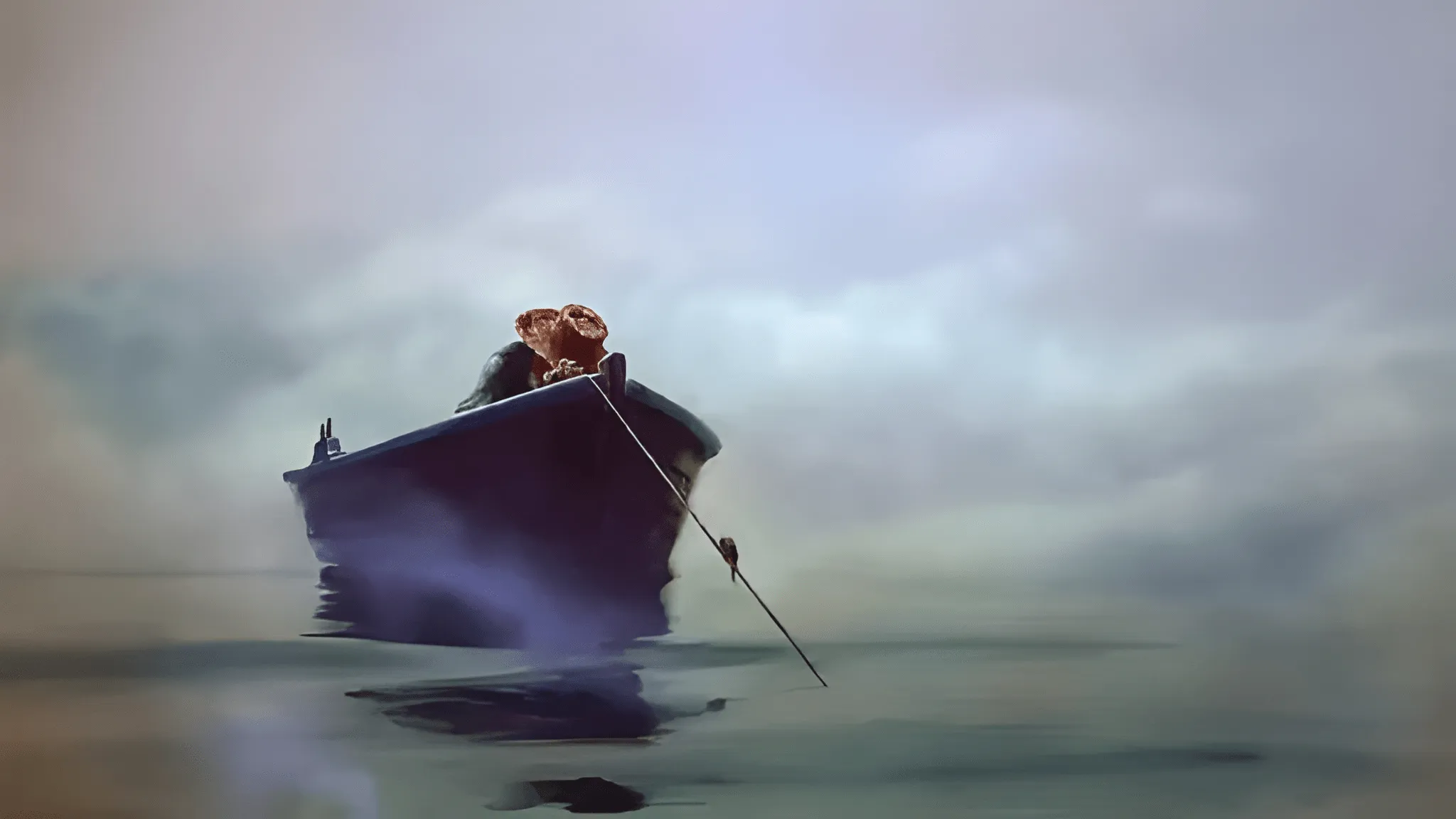
On the other hand, the second scenario is where most of the story is set: over a few days and nights in the Gulf Stream off the coast of Havana. Surrounded by water, the sea shows how big Santiago’s personal quest is. Moreover, as he goes further into the sea, Santiago reflects on how small he has become.
“It was getting late in the afternoon and he saw nothing but the sea and the sky.” (p. 32)
This state of solitude in which Santiago is found makes us ponder nature’s magnificence and human loneliness.
3. Character Analysis
Santiago
The main character of this story is Santiago, a brave man who refuses to give up after:
“He had gone eighty-four days now without catching a fish.” (p. 2)
Santiago’s determination and resilience stand out from the early stages of the story, as he is determined to catch a fish after a long streak of bad luck.
Nevertheless, as Santiago sails out to sea, convinced that he will catch a fish, this reveals his pride and humility. He acknowledges his age and condition but is still confident in his fisherman skills, which unveils his pride and humility—other core traits that characterize Santiago.
Likewise, he deeply conveys a connection to nature that clearly stands out in some moments of the story, such as his fight against the marlin. He praises the sea by attributing a gender, a name, and human-like attributes to it.
Although Santiago’s personality traits are exposed in the early stages of the story, we can deep dive into his deeper thoughts and his unique philosophy about life through his loneliness.
Overall, Santiago’s philosophy revolves around struggle. He perfectly represents the strength of a person who keeps fighting even when the world seems against him.
Manolin
On the other hand, Manolin (the boy) is a character worth mentioning despite his infrequent appearance.
Santiago and Manolin form a perfect synergy, as one complements the other. Santiago is old and wise from years of experience, while Manolin is young and eager to learn.
Personally, this duality soothed my nerves during the moments when Santiago’s condition seemed questionable because the boy’s companionship brings warmth and emotional support to his life.
His loyalty and admiration serve as a foundation for Santiago’s strength and resilience. Even when others doubt the old man, Manolin remains by his side.
Early in the novel, it is revealed that:
“The boy’s parents had told him that the old man was now definitely and finally salao.” (p. 2)
It is also stated that:
“Many of the fishermen made fun of the old man, but he was not angry.” (p. 3)
These moments highlight how, despite social pressure, Manolin continues to believe in Santiago, showing the depth of his loyalty.
The Marlin
Lastly, although the marlin is not human, it is extremely important to mention in this section because it represents a major point of inflection in the story.
The marlin is not only a fish; it is a powerful symbol of challenge. It also represents the ultimate test of Santiago’s fisherman skills and his human spirit, as both are strong and noble opponents.
4. Critical Evaluation
The novel explores universal themes such as struggle, pride, resilience, and defeat.
However, it remained unclear to me whether Santiago’s defeat was truly a lost match or not. I personally found it too vague, as there was no profound symbolism in it. As a reader, I was expecting a jaw-dropping ending considering the climax of the story, which was full of tension and uncertainty. However, the author played it safe and went with a realistic yet emotional ending.
I can categorize the ending from two different points of view: a masterpiece of realism or an unsatisfying conclusion. I cannot decide which one I would go with, but I can say I was not satisfied whatsoever.
On the other hand, one aspect that I liked the most about the story was how the author artistically paints the different scenarios in the readers’ minds through his clear, concise, and poetic descriptions. These descriptions create a calm but intense atmosphere, which is perfect for readers who like to visualize the different scenes as the author intended.
When it comes to the plot, the author did not cross the line of reality, giving the story a sense of simplicity. This helps the core themes of the plot shine.
5. Conclusion
In conclusion, the story left me reflecting on some important topics, one of them being the strength needed to face life’s challenges.
I found Santiago to be a very remarkable character because of his development ever since the early stages of the story. Moreover, at a general level, this story has a powerful message that quite amazed me.
If I had to define this story with only two words, I would definitely go with perseverance and success. These can be opposite concepts, but they complement one another perfectly.
Moreover, another takeaway is the bond between the boy and the old man, which I can interpret as a two-way relationship that ensures the continuation of Santiago’s philosophy and values through Manolin. These values will live on, and hence Santiago’s spirit will live forevermore.
Lastly, I would say that this story is an invitation to whoever reads it to keep sailing their boat and fighting against the sharks—or whatever difficulties may arise—in the sea of life.